Washington Update

Stay Informed With NACBA’s Latest Washington Update

NACBA’s Krista D’Amelio keeps you updated and informed about significant and relevant activity on the part of Congress, regulatory agencies and interest groups/think tanks.  Take a look at what’s happening in DC in the latest Washington Update.

ON THE HILL On October 11th Rep. John Garamendi (D-CA) and Rep. Brian Fitzpatrick (R-PA) introduced the bipartisan Student Loan Refinancing and Recalculating Act, H.R. 4001, to address the ballooning student loan debt crisis in America that cripples over 40 million Americans and their families. This legislation would allow students to refinance their student loan interest rates, lower future student loan interest rates, eliminate origination fees on student loans, delay student loan interest rate accrual for low-income and middle-class borrowers while they are pursuing their education, and allow for borrowers in medical or dental residencies to defer payments until the completion of their program.

Chief Deputy Whip Patrick McHenry (R-NC), the Vice Chairman of the House Financial Services Committee introduced H.R. 4028, the Promoting Responsible Oversight of Transactions and Examinations of Credit Technology Act of 2017, or the PROTECT Act, on October 12th. Following the data breach at Equifax that exposed the personal data of over 140 million Americans, this bill would require the federal government to create uniform cybersecurity standards for credit bureaus and submit them to onsite examinations. The bill would also create a national framework for credit freezes so that victims of identity theft, active military personnel, people over 65 years of age, and children are protected. Finally, the bill would stop the credit bureaus from using Americans’ Social Security Numbers as a basis for identification by 2020.

IN THE AGENCIES The U.S. Department of Education recently released data on the national student loan FY 2014 cohort default rate. The rate increased slightly from 11.3 percent to 11.5 percent for students who entered repayment between fiscal years 2013 and 2014. During the tracking period for the FY 2014 borrower cohort (Oct. 1, 2013 to Sept. 30, 2016), more than five million borrowers entered repayment, and 580,671 of them—or 11.5 percent—defaulted on their loans. Those borrowers attended 6,173 postsecondary institutions across the nation.

The Consumer Financial Protection Bureau (CFPB) finalized a rule that is aimed at stopping payday debt traps by requiring lenders to determine upfront whether people can afford to repay their loans on October 5th. These strong protections cover loans that require consumers to repay all or most of the debt at once, including payday loans, auto title loans, deposit advance products, and longer-term loans with balloon payments. The Bureau found that many people who take out these loans end up repeatedly paying expensive charges to roll over or refinance the same debt. The rule also curtails lenders’ repeated attempts to debit payments from a borrower’s bank account, a practice that racks up fees and can lead to account closure.

FROM THE INTEREST GROUPS On September 27, 2017 following the U.S. Trustee Program’s (USTP) recently issued guidelines for natural disasters, NACBA and NCLC wrote a joint letter urging for approval of a waiver of credit counseling requirements in the areas of Texas, Florida, and Puerto Rico affected by Hurricanes Harvey, Irma, and Maria. NACBA and NCLC received a response on October 4th from the USTP. Specifically, the response letter calls to light the action of acting US Trustee Guy Gebhardt issuing a temporary waiver of credit counseling and debtor education requirements for the areas in Puerto Rico and US Virgin islands affected by Hurricanes Irma and Maria.

NCLC released findings on October 11th that reveals discretionary pricing and racial disparities in auto add-on products sold by car dealers. Their report:  Auto Add-Ons Add Up: How Dealer Discretion Drives Excessive, Arbitrary, and Discriminatory Pricing, is an analysis of a national data set of three million add-on products sold from September 2009 through June 2015. Key findings include: add-ons lead to unreasonably high and inconsistent pricing, and Hispanics pay higher prices than non-Hispanic customers for the same product.

Feedback should be directed to Krista.DAmelio@NACBA.com
NACBA’s Latest Washington Update


Read the latest update from Washington, designed to keep NACBA members informed about significant and relevant activity on the part of Congress, regulatory agencies and interest groups/think tanks.

ON THE HILL  A vote in Senate on the Consumer Financial Protection Bureau’s arbitration regulation is imminent. Republican leaders are considering whether to bring to the Senate floor a bill that would kill the arbitration regulation finalized by the CFPB this summer using a special legislative tool that allows them to avoid a Democratic filibuster if they act within 60 legislative days of implementation. Senators Johnny Isakson (R-GA) and David Perdue (R-GA) are cosponsors of the legislation in the Senate. The debate comes three weeks after a public outcry compelled the Atlanta-based Equifax to quickly drop so-called forced arbitration language from the terms of service of the free credit monitoring service it was offering its customers after its massive data breach. The House of Representatives already passed a “resolution of disapproval” to revoke the CFPB’s arbitration rule. A total of 23 Senate Republicans filed a resolution at the end of July to rescind the CFPB rule. Senator Sherrod Brown (D-OH), ranking member of the Senate Committee on Banking, Housing, and Urban Affairs, has promised to fight to keep the rule.

IN THE AGENCIES On September 14th, Clifford White, Director of the Executive Office of the U.S. Trustees addressed the National Association of Bankruptcy Trustees at the 35th Annual Convention. He discussed topics that included chapter 7 trustees, guidance on natural disasters, marijuana assets, and stale debt claims—to name a few. Amongst things he noted for natural disaster guidelines were: the US Trustee Program (USTP) will not take enforcement action against debtors who are unable to file or produce documents required by the Code as a result of a natural disaster, if they otherwise are eligible for relief; USTP will not move to dismiss under the “means test” if income loss, increased expenses, or other consequences of a natural disaster constitute “special circumstances” sufficient to rebut the presumption of abuse; and even if conditions do not justify a United States Trustee granted statutory waiver of the credit counseling requirements for a district, USTP will exercise prosecutorial discretion in considering whether to take action to dismiss the case of a debtor who, as a result of a natural disaster, experiences difficulty in obtaining a credit counseling certificate or whose filing was delayed beyond the 180-day period following the debtor’s receipt of credit counseling.

The Federal Trade Commission launched a web page highlighting the work of the agency’s new Military Task Force, which is aimed at identifying the needs of military consumers and developing initiatives to empower servicemembers, veterans, and their families, including through law enforcement actions. The Military Task Force, comprised of a cross-section of agency representatives, is part of the FTC’s ongoing and collaborative effort to provide resources for the military community. Servicemembers, like all consumers, are potential targets for fraudsters. Certain scams are more likely to target the military community because those families may relocate frequently and because many service members are living on their own and earning a paycheck for the first time.

FROM THE INTEREST GROUPS Following the U.S. Trustee Program’s recently issued guidelines for natural disasters mentioned above, NACBA and NCLC wrote a joint letter urging for stronger relief for bankruptcy debtors in Texas, Florida, and Puerto Rico proportionate to the serious problems those hurricane victims are now facing. Specifically, NACBA and NCLC request USTP approve a waiver of credit counseling requirements in the areas of Texas, Florida, and Puerto Rico affected by Hurricanes Harvey, Irma, and Maria.

OTHER A report was recently published that analyzed issues of bankruptcy and race in America. Interested parties can access the report online.


Feedback should be directed to Krista.DAmelio@NACBA.com
Stay Informed With NACBA’s Latest Washington Update

Read the latest update from Washington, designed to keep NACBA members informed about significant and relevant activity on the part of Congress, regulatory agencies and interest groups/think tanks.

On The Hill The Senate unanimously approved legislation on September 8th by Judiciary Committee Chairman Chuck Grassley (R-IA) and Senator Al Franken (D-MN) clarifying Congress’ intent to allow family farmers to more easily reorganize their finances when they fall on hard times. S. 1237 Family Farmer Bankruptcy Clarification Act of 2017 reiterates Congress’ earlier action to enable bankrupt family farmers reorganizing their debts to treat capital gains taxes owed to a governmental unit, arising from the sale of farm assets during a bankruptcy, as general unsecured claims.  It also removes the Internal Revenue Service’s veto power over a bankruptcy reorganization plan’s confirmation, giving the family farmer a chance to reorganize successfully.

On September 6th Senator Coons’ (D-DE) bill S. 1107, Bankruptcy Judgeship Act of 2017, passed the Senate. The bill extends temporary bankruptcy judgeships and calls for a five-year extension for 14 temporary bankruptcy judgeships and will create four new bankruptcy judgeships. With this bill, Delaware will retain its one permanent bankruptcy judge, will receive extensions of its five temporary bankruptcy judges and will receive an additional two temporary bankruptcy judgeships for five years to handle the heavy caseload for the district, which is one of the busiest in the country.

Representative Sean Duffy (R-WI) is pushing to have federal flood insurance reformed to avoid bankruptcy and to allow private insurance to run the program as opposed to the federal government. He wants to set flood insurance up so that the private market can come in and offer premiums and coverage at better prices than the federal government. Duffy agrees that helping Texas is the right thing to do, but warned continued subsidies to flood areas is not fiscally sound, and encouraged Congress to think about future disasters on the horizon.

In The Agencies On September 1st the Education Department has notified the Consumer Financial Protection Bureau (CFPB) that it’s severing operating agreements with it, saying the regulatory body has “undermined” the mission to serve students and borrowers — particularly in its handling of student loan servicing issues. A copy of the letter notifying the CFPB of the decision was released Friday by Representative Virginia Foxx (R-NC), chairwoman of the House Education and the Workforce Committee. It’s signed by A. Wayne Johnson, chief operating officer of the Education Department’s Office of Federal Student Aid, and Kathleen Smith, acting assistant secretary in the Office of Postsecondary Education, and dated Thursday. It is claimed that the CFPB is using its jurisdiction in areas that Congress never intended.

OTHER Following the recent Equifax breach, U.S. Senator Sherrod Brown (D-OH), ranking member of the U.S. Senate Committee on Banking, Housing, and Urban Affairs, is calling on Equifax to immediately remove forced arbitration from all services offered to customers following a data breach that exposed 143 million Americans to identify theft. Equifax is currently touting free credit monitoring and identify protection services for victims of the breach through its TrustedID product. However, Equifax included forced arbitration clauses in the terms of use agreement customers must agree to when signing up for the services – effectively forcing victims of the breach to sign away their rights to seek access to court.

Feedback should be directed to Krista.DAmelio@NACBA.com

Stay Informed! Read NACBA’s Washington Update

Check out the latest update from Washington, designed to keep NACBA members informed about significant and relevant activity on the part of Congress, regulatory agencies and interest groups/think tanks.

On The Hill Senators Elizabeth Warren (D-MA) and Al Franken (D-MN) sat down to discuss CFPB’s arbitration rule in a Facebook video published on Senator Warren’s page. View the video to hear the advice they provide on what viewers can do to stop Congress from “selling out to the big banks”.

In The Agencies The Consumer Financial Protection Bureau (CFPB) has filed an amicus brief in support of the Department of Education’s (ED) appeal asking the U.S. Court of Appeals for the Federal Circuit to vacate a preliminary injunction entered by the Court of Federal Claims that bars the ED from assigning defaulted student loans to certain small business private collection agency contractors and other contractors.  The injunction was issued in a lawsuit filed by companies challenging ED decisions not to award or continue contracts with such companies to collect student loans. The CFPB argues that by preventing the ED from assigning debt collectors to defaulted loans, the preliminary injunction impedes or prevents borrowers from managing their federal student loan debt.

More on CFPB. On August 25, 2017 CFPB issued the 2017 HMDA Final Rule that amends Regulation C to implement amendments to the Home Mortgage Disclosure Act made by section 1094 of the Dodd-Frank Wall Street Reform and Consumer Protection Act (Dodd-Frank Act). CFPB added several new reporting requirements, clarified existing requirements and modified institutional and transactional coverage of Regulation C. The final rule also provides extensive guidance regarding compliance with both the existing and new requirements.

The Trump administration has selected Julian Schmoke Jr. to serve as the Department of Education’s new chief enforcement officer. Schmoke is a former for-profit college official who previously directed campus operations at West Georgia Technical College and served as a dean at DeVry University. He will lead the Department’s unit that polices fraud in higher education. Specifically, Schmoke will lead the Student Aid Enforcement Unit established by the Obama administration to more aggressively combat fraud and deceptive practices at colleges and universities. Sens. Sherrod Brown (D-OH), Patty Murray (D-WA), Dick Durbin (D-Il) and Elizabeth Warren (D-MA) wrote a letter to Secretary DeVos urging that the person selected must “have relevant experience in consumer protection or litigation, managing attorneys, and conducting investigations with the highest ethical standards.” The unit Schmoke will oversee is also responsible for processing debt relief claims filed by federal student loan borrowers who say they’ve been defrauded by their college.

OTHER It is being reported that in the wake of Hurricane Harvey, about 80% of homeowners in the areas devastated by the hurricane lack flood insurance. This leaves many who escaped the storm with little financial help to rebuild their homes and lives. The Washington Post reports that only 17 percent of homeowners in the eight counties most directly affected by Harvey have flood insurance policies that cover up to $250,000 in rebuilding costs and $100,000 to replace personal belongings such as TVs and furniture. Losing a home without insurance compensation is financially devastating. A total loss could delay retirement or force people into bankruptcy.

Wells Fargo is now revealing it has found a total of up to 3.5 million potentially fake bank and credit card accounts, up from its earlier tally of approximately 2.1 million. The additional fake accounts were discovered by a previously-announced analysis that went back to January 2009 and that reviewed the original May 2011 to mid-2015 period. Moreover, Wells Fargo also revealed that thousands of customers were enrolled in online bill pay without their authorization. The review found 528,000 potentially unauthorized online bill pay enrollments.

Feedback should be directed to Krista.DAmelio@NACBA.com

Washington Update- August 18th

Krista D’Amelio gives the latest update from Washington, designed to keep NACBA members informed about significant and relevant activity on the part of Congress, regulatory agencies and interest groups/think tanks.  Take a look at what’s happening in DC in the Washington Update.

On The Hill U.S. Senator Elizabeth Warren (D-MA) sent letters on August 10th to the heads of JP Morgan Chase, Bank of America, Wells Fargo & Company, Citigroup Inc., U.S. Bancorp, PNC Financial Services Group Inc., TD Group US Holdings, Capital One Financial Corporation, HSBC North America Holdings, Charles Schwab Corporation, BB&T Corporation, Suntrust Bank, Barclays US, Ally Financial Inc., American Express Co. and Citizens Financial Group. In these letters, she requests information on the banks’ stances on the arbitration rule, along with data on the firms’ use of arbitration clauses in consumer agreements and the outcomes of arbitration proceedings. Warren has asked for responses by September 1 because Republicans have introduced a CRA resolution to reverse the CFPB rule. Warren is the ranking member of the Senate Banking Committee’s Subcommittee on Financial Institutions.

Full text of H.R. 3553 has been released. As you may recall from the previous Washington Update, the bill was introduced by Congressman Tom Marino (R-PA) on July 28th to amend title 11 of the United States Code to increase the amount of compensation paid to chapter 7 bankruptcy trustees for services rendered.

On August 17thPresident Trump signed into law H.R. 3218, the Harry W. Colmery Veterans Educational Assistance Act of 2017, also known as the “Forever GI Bill,” named after the American Legion national commander who wrote the original GI Bill language in 1944. This legislation contains 34 new provisions, the vast majority of which will enhance or expand education benefits for Veterans, Servicemembers, Families and Survivors. Most notably, Veterans who transitioned out of the military after January 1, 2013 will not be limited to the 15-year deadline to use their GI Bill benefits. This law also restores benefits to Veterans, who were impacted by school closures since 2015, and expands benefits for our reservists, surviving dependents, Purple Heart recipients, and provides many other improvements.

In The Agencies The Department of Education submitted a notice in the Federal Register on August 17th regarding the gainful employment rule that would delay appeals and leave the future of failing programs up to Secretary  DeVos. The gainful employment regulation requires schools to give prospective students key information about costs and outcomes of career education programs at for-profit, public, and nonprofit colleges, ends federal funding for programs that consistently leave students with debts they cannot repay, and allows colleges to appeal if they believe program graduates earn more than federal data indicate. The document establishes new deadlines for submitting notices of intent to file alternate earnings appeals and for submitting alternate earnings appeals. Normally, appeals would be due in February 2018 and warnings are not required by failing programs that intend to say they intend to appeal.

More from the Department of Education. On August 14th, the Department told a federal appeals court that a court order blocking its ability to send any newly defaulted student loan borrowers to its hired debt collectors has cost taxpayers more than $5 million in lost collections since March. In addition, the Education Department now estimates that 463,000 borrowers are stuck in default limbo because they haven’t been assigned a debt collection firm. This lawsuit came about because private debt collection agencies that were not awarded the latest collection contract sued the Department of Education. After the judge overseeing the litigation issued an order preventing the Department from assigning new accounts to debt collectors, the Department announced a re-do of the contract and is now rushing to make a final award by the end of next week.

The Consumer Financial Protection Bureau released new data on August 16th that found nearly half of student loan borrowers leave school owing at least $20,000 – double the share of borrowers a decade ago. Further, the data shows that people are taking on more student debt later in life, and having a tougher time paying it back. 44 million Americans currently owe money and the combined total of outstanding federal and private student loan debt now exceeds $1.4 trillion.

Feedback should be directed to Krista.DAmelio@NACBA.com
What’s Happening in DC? Find Out In Today’s Washington Update

NACBA Staff member, Krista D’Amelio gives us the latest update from Washington. Stay informed about significant and relevant activity on the part of Congress, regulatory agencies and interest groups/think tanks.

On The Hill On Tuesday, July 25 the House of Representatives passed H.J. Res. 111, a resolution to repeal the new Consumer Financial Protection Bureau (CFPB) rule to restore consumers’ ability to join together and hold banks and lenders accountable in class action lawsuits when they break the law. The CFPB issued the arbitration rule on July 10, 2017, an effort to restrict banks and lenders’ use of forced arbitration — fine-print clauses in contracts for credit cards, bank accounts, and other financial products that prevent people from banding together to challenge fraud by big banks. Representative Walter Jones (R-NC) was the only Republican to vote no on H.J. Res. 111. A full list of recorded votes has been posted on the House Clerk website. The Senate is expected to vote on a similar bill filed as S.J Res. 47.

H.R. 3553 was introduced by Congressman Tom Marino (R-PA) on July 28th to amend title 11 of the United States Code to increase the amount of compensation paid to chapter 7 bankruptcy trustees for services rendered. Congressman Ed Perlmutter (D-CO) co-sponsored the bill and a summary is in progress.

In The Agencies The Federal Trade Commission (FTC), state, and local authorities will convene a conference in Los Angeles on Sept. 7, 2017, to help educate military consumers and train military attorneys, law enforcement personnel, and consumer protection officials to address consumer fraud and other issues that affect servicemembers and their families. This event follows the FTC’s recent successful Military Consumer Financial Workshop, held July 19 in San Antonio. More information can be found by visiting the FTC’s website.

FROM THE INTEREST GROUPS On August 1, 2017, the Economic Policy Institute released a fact sheet debunking industry claims that consumers recover more money in arbitration than class actions. They re-examined data from the CFPB study and found that the average consumer is ordered to pay their bank or lender $7,725 in arbitration. The EPI findings conclude that class actions return hundreds of millions to consumers, while forced arbitration only pays off for banks and lenders.

On July 13, 2017, Director of the U.S. Trustee Program Clifford White addressed the National Association of Chapter 13 Trustees at their 52nd annual conference. During his speech, Director White spoke on issues including: marijuana assets in bankruptcy, stale debt claims, efforts to fight fraud and debt abuse, debtor education and the Department of Justice’s proposal for a uniform national chapter 13 plan. You can read Director White’s entire speech on the Department of Justice website.

Feedback should be directed to Krista.DAmelio@NACBA.com
Bankruptcy News Briefs 7/21

Headlines Wrapping Up the Week…

Congress Moves to Take Away Consumers’ Right to Day in Court

Breaking News: CFPB Publishes Update to Debt Collection Rulemaking Timeline

DOR May Not Collect Child Support Arrearage Outside Plan

These are the worst states for student debt

Debtor who Filed Chapter 13 Soon After his Ex-Wife Sued him in State Court to Enforce Equitable Distribution Award Did Not File Case in Bad Faith

Controversial CFPB Rule Exposes Financial Services Companies To Greater Class Action Risk

FTC Announces Charges Against Debt Collection Operation for FDCPA and FTC Act Violations

Medical debt relief is coming

Measure calling for Maine to pay down student debt stalls in Legislature

Renew Your Membership  For a Chance to Win This Great Resource!

It’s a new month and that means when you renew your membership in July you are automatically entered to win a copy of NCLC Consumer Bankruptcy Law and Practice Volume I & II, Eleventh Edition (Value $130). Two winners will be selected at random each month.

Introduce a New Member to NACBA & Receive a $25 Amazon Gift Card! 

In honor of NACBA’s 25th Anniversary, we want to reward you with a $25 Amazon Gift Card! Introduce a new member to NACBA and we will send you $25 Amazon Gift Card. Not only will YOU receive a $25 Amazon Gift Card but the NEW MEMBER will also receive a $25 Amazon Gift Card! Check out the requirements and start referring today!

Register for NACBA’s August Webinar

Did you enjoy yesterday’s webinar? Well, get ready for another stellar webinar in August! Register Today!


Save the Date for the 2018 NACBA Annual Convention on April 19-22 at the Sheraton in Downtown Denver!

Bankruptcy News Briefs 7/20

End of the Week Headlines…

CFPB Releases Effective Date for Arbitration Rule

Consumer Credit Delinquencies Increase in First Quarter

Consumer’s Credit Repair Agreement Becomes Issue in Collection Dispute

Challenges to Tax Exempt Status of Bankrupt Non-Profits

5th Cir. Holds Debt Collector’s Obligation to Report Debt as Disputed Not Limited By § 1692g

Big Bank Bankruptcy Bill Back on Table; Will It Prevent Meltdown?

CFPB Enforcement Actions Fall Off in Second Quarter

Ch. 13 Trustee Must Return Plan Payments on Dismissal

Republicans launch Congressional Review Act challenge to CFPB class-action rule

New York attorney general investigates student debt collector for missing paperwork

Judge denies law firm’s motion to dismiss debt collection lawsuit

Houston Debt Collection Lawyer Hit with $25 Million DTPA Judgment

Recent Bankruptcy Decision from the Western District of Wisconsin Discusses Negative Equity, Car Loans, and the Chapter 13 Cram Down

Today is the Day! Are You Registered?


Register Today!

Washington Update

Krista DAmelio gives you the latest update from Washington! Stay informed about significant and relevant activity on the part of Congress, regulatory agencies and interest groups/think tanks with NACBA. Read it today!

Introduce a New Member to NACBA & Receive a $25 Amazon Gift Card! 

In honor of NACBA’s 25th Anniversary, we want to reward you with a $25 Amazon Gift Card! Introduce a new member to NACBA and we will send you $25 Amazon Gift Card. Not only will YOU receive a $25 Amazon Gift Card but the NEW MEMBER will also receive a $25 Amazon Gift Card! Check out the requirements and start referring today!

Save the Date for the 2018 NACBA Annual Convention on April 19-22 at the Sheraton in Downtown Denver!


Bankruptcy News Briefs 7/19

What’s Happening in Midweek News?

Big Changes to West Virginia Debt Collection Laws Now in Effect

How New Credit Reporting Guidelines May Impact Consumers…and Lenders

Automatic Stay Does Not Preclude Criminal Restitution Collection

CFPB ignores request from OCC to postpone arbitration rule

Poll: Voters Support CFPB, Strict Financial Regulation

The economy has improved but money worries persist

Debt collector must face suit for accessing credit report

Second Circuit Holds that Contractually-Given Consent Cannot be Revoked Under TCPA

Consumers Making Less Than $40K Per Year Worried About Paying Off Debt

What kind of financial shape is your state in?

Annual bankruptcy filing total could approach 800K

Free of debt — with regrets

1,600 lawsuits filed in Colorado courts against students delinquent on school loans

Third Circuit Confirms That One Call Is All for TCPA Violation

District Court Confirms That Text Messages Completing Consumer-Initiated Transaction Are Not Telemarketing

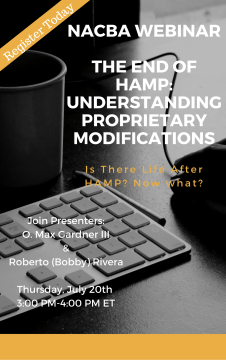
Register for Tomorrow’s Webinar!


Don’t  miss tomorrow’s informative Webinar with O. Max Gardner III and Bobby Rivera as they discuss the following topics:

  • Finding the Investor or Guarantor of the Loan
  • Pooling & Servicing Agreements
  • GSE Published Guidelines
  • “Standard Modifications” and basic terms of some Proprietary Mod Programs
  • Common Terms & Formulas used in all Loan Modifications
  • Streamlined Mods and Not So Streamlined Mods
  • How Servicers Pick Loans for Alternative Mod Products
  • How to Determine Which Mods Your Client Can really Qualify for and How to Get them
  • How to Select the Right Client

Register Today!

Washington Update

Krista DAmelio gives you the latest update from Washington! Stay informed about significant and relevant activity on the part of Congress, regulatory agencies and interest groups/think tanks with NACBA. Read it today!

Introduce a New Member to NACBA & Receive a $25 Amazon Gift Card! 

In honor of NACBA’s 25th Anniversary, we want to reward you with a $25 Amazon Gift Card! Introduce a new member to NACBA and we will send you $25 Amazon Gift Card. Not only will YOU receive a $25 Amazon Gift Card but the NEW MEMBER will also receive a $25 Amazon Gift Card! Check out the requirements and start referring today!

Save the Date for the 2018 NACBA Annual Convention on April 19-22 at the Sheraton in Downtown Denver!


Find out What’s Happening in DC in NACBA’s Washington Update -July 14th

Krista D’Amelio keeps NACBA members informed about significant and relevant activity on the part of Congress, regulatory agencies and interest groups/think tanks in our Washington Update.

On The Hill On Wednesday, July 12, 2017, the House Financial Services Committee held a hearing titled: “Monetary Policy and the State of the Economy”. The witness list included the Honorable Janet Yellen, Chair of the Board of Governors of the Federal Reserve System. In her testimony, Yellen described an economy that appears generally strong, with continued job gains and low unemployment, but that is affected by stubbornly low inflation. During the hearing, House members pressed Yellen on how the Federal Reserve would roll back its balance sheet, the central bank’s role in ensuring full employment and her views on bank supervision. One point of interest came during Full Committee Chairman Jeb Hensarling’s (R-TX) round of questioning. He asked whether the Federal Reserve would ever buy student loans, to which Yellen answered she was unsure about student debts, but can confirm the purchase of Treasury and Agency Securities. Hensarling continued to probe on whether the Federal Reserve has any plans to buy student loans because if the reserve did, it could conceivably forgive student loans of current graduates.

In The Agencies On Monday, July 10, the Consumer Financial Protection Bureau (CFPB) announced a new rule to ban companies from using mandatory arbitration clauses to deny groups of people their day in court. Many consumer financial products like credit cards and bank accounts have arbitration clauses in their contracts that prevent consumers from joining together to sue their bank or financial company for wrongdoing. The CFPB’s rule restores consumers’ right to file or join group lawsuits. By so doing, the rule also deters companies from violating the law. Under the rule, companies can still include arbitration clauses in their contracts, but companies subject to the rule may not use arbitration clauses to stop consumers from being part of a group action. The rule also makes the individual arbitration process more transparent by requiring companies to submit to the CFPB certain records, including initial claims and counterclaims, answers to these claims and counterclaims, and awards issued in arbitration.

OTHER On Wednesday, July 12, 2017, NACBA along with 55 other coalition groups led by The Institute for College Access and Success (TICAS), sent a letter to U.S. Secretary of Education Betsy DeVos strongly opposing the delay, dismantling, or weakening of the gainful employment regulations finalized in October 2014 and the “borrower defense to repayment” and college accountability regulations finalized in November 2016. In the letter, it was argued that the existence of a new rulemaking process provides no basis for the Department to refuse to implement and enforce the current regulations in the interim. If the Department wishes to alter current regulations, it must do so through negotiated rulemaking, not unilaterally outside the processes established by Congress. Please email Krista D’Amelio to obtain a final copy of the letter.

Feedback should be directed to Krista.DAmelio@NACBA.com